

What are the Carlsberg Marston Brewing Company (and Marston’s) up to?
The Carlsberg Marston Brewing Company (CMBC) were back in the spotlight recently after announcing the forthcoming closure of Banks’s Brewery in Wolverhampton. Then again, after it was revealed that eleven brands are to be axed. It seems an odd move, for the biggest brewer of cask ale in the UK (therefore the world) to be wringing their hands and say that cask is in terminal decline and there’s nothing they can do except basically move on. In fact, as usual, Pete Brown has already written about it and outlined the situation better than I ever could in a recent blog post.
The closure of an historic brewery and the loss of a number of well known (but not necessarily well liked, hence the issue) brands is roundly decried as A Bad Thing. But I’ve noticed quite a lot of general confusion about what’s happening and why. I’ve also noticed that a couple of key details seem to have been missed relating to the CMBC/Marston’s tale. So I’ve taken it upon myself to try and clear things up. Or at least to try and get everything straight in my own mind, so I can form an opinion on it. I’ll probably get the odd detail wrong and I welcome corrections and debate in the comments so we can form a fuller picture together.
The Carlsberg Marston Tour of Destruction
It started with a merger. In 2020, historic Danish brewer Carlsberg entered into a merger with historic English brewer and pubco Marston’s. The joint venture was split 60/40 in Carlsberg’s favour. The Carlsberg Marston Brewing Company was formed. The agreement included Marston’s six breweries and distribution depots, but not the pubco side of the business – although there was an agreement that would allow Carlsberg products to make their way into Marston’s pubs. So we have CMBC with the UK brewing assets of Carlsberg and Marston’s, and the Marston’s chain of pubs – linked but separate. The move was reported to have reduced Marston’s debt by £200m.
Then the fun really started. The assets began to be divested or closed. Carlsberg had bought the London Fields Brewery in 2017. They sold it to the Grace Land Group in 2022. This is probably the best news out of everything in this blog post. In the same year, Marston’s 19th century Jennings Brewery was closed and the Eagle Brewery in Bedford was sold to Spanish brewer Damm. The Marston’s Visitor Centre was also closed, quietly. Silently in fact. I only discovered it was gone when I was researching Molson Coors’ closure of the National Brewery Centre in Burton for The Telegraph. It was at that time I made the first iteration of the graphic below – a facsimile of CAMRA’s Whitbread Tour of Destruction t-shirt from 1990. I’ve been dutifully updating it every 9 months or so ever since.
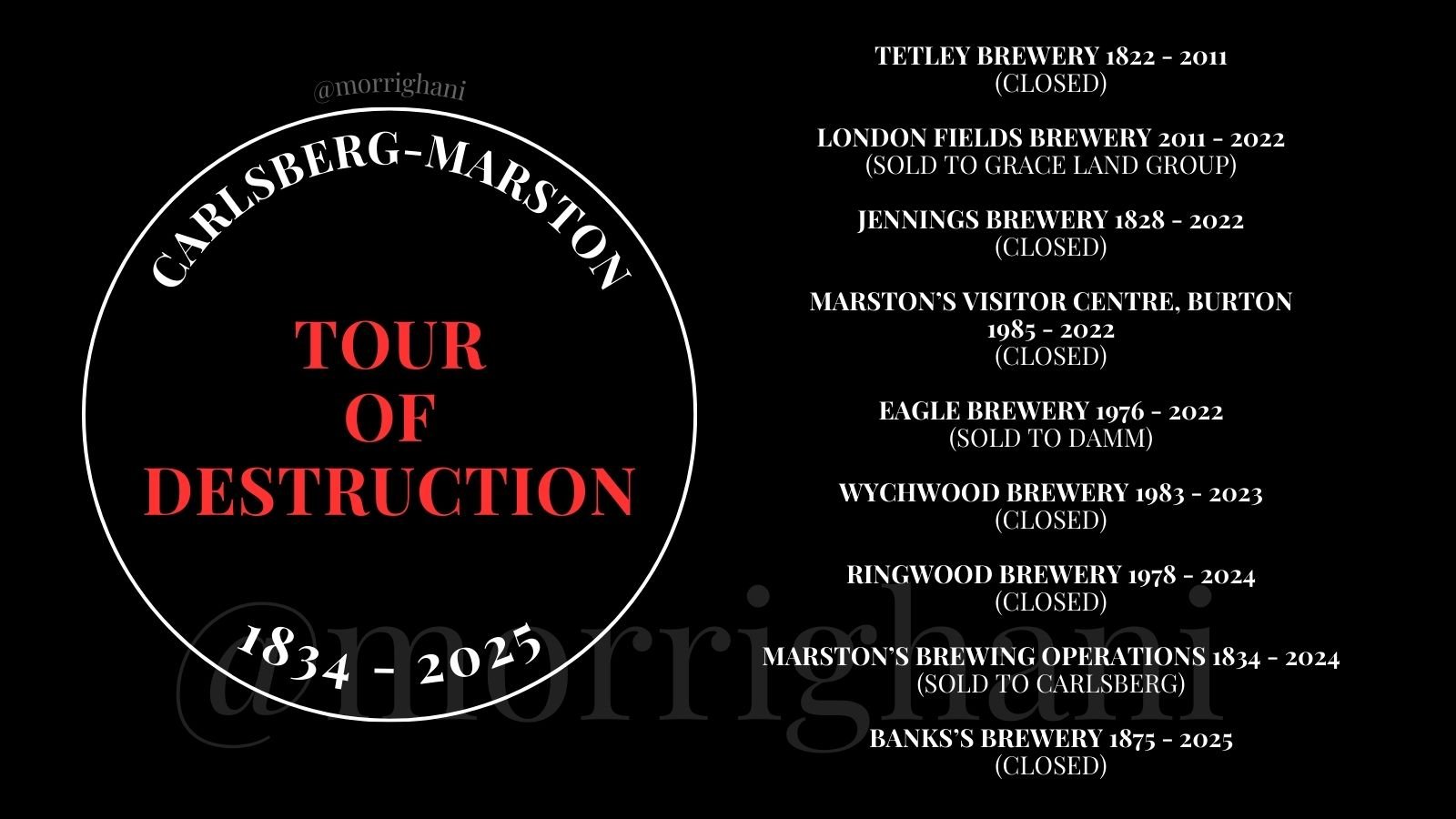
The Cull Continues
Commentators and ale lovers were getting pretty uneasy by this point. The biggest cask ale brewer was apparently getting rid of all of their breweries. The announcement of the closure of Oxfordshire’s Wychwood Brewery in 2023, followed by Hampshire’s Ringwood Brewery in 2024 had a dull sense of inevitability about them by this point. Some of the key beer brands were retained, to be brewed in the remaining CMBC breweries. That’s why you still see Hobgoblin around, even though the Wychwood is now long gone.
Edit: Of course I forget to mention the retirement of the Union Sets in January 2024.
There is a concession to be made here, because (under pressure from Garrett Oliver it would seem) CMBC did facilitate the moving, installation and cooper support for two sets to be taken to Thornbridge Brewery in Derbyshire and Epochal Brewing in Glasgow. They didn’t have to do that, they could have left them to rot. My understanding is that there is one set left that is earmarked for display, but we’ll see – since there is no Marston’s Visitor Centre any more, and no serious replacement for the National Brewery Centre as yet on the horizon.
In July 2024, Marston’s announced that they would be selling their 40% stake in CMBC to Carlsberg for £206m. So that will be the end of Marston’s The Brewer, after some two centuries. But, as Pete Brown mentioned in the blog post I’ve linked above, CMBC assured us there was nothing to worry about. Cask ale was in safe hands with them. British brewing heritage was in safe hands. Quite contrary to the evidence we’d seen in the previous four years really. And, I presume, when the deal is finalised, there will be no more CMBC – we’ll just go back to Carlsberg without the “M”. Who knows, maybe without the “B” either, rate they’re going. So now we have the nominal CMBC (which is Carlsberg in waiting) and Marston’s with a small “m” the pubco, with somewhere in the region of 1300 pubs to their name.
Mere moments later, in October 2024, CMBC announced the forthcoming closure of Banks’s Brewery in Wolverhampton. Yet another 19th century brewery (and the jobs that go with it) lost. And finally we’re bang up to date with the loss of these eleven beer brands.
The Beer Confusion
Now. Lots of people have been writing about the beer brands that are being axed and there is a lot of clutching of pearls. But there are a few things to note about the latest announcement.
CMBC haven’t announced anything formal at all. CAMRA issued a press release based on information they were privy to. If you take a little look, you can see that some bottled beers are delisted on the Marston’s webshop. But that’s it as far as “official” information goes.
The list that everyone has been working from, CAMRA’s list, is:
- Banks’s Mild
- Banks’s Sunbeam
- Bombardier (keg)
- Eagle IPA
- Jennings Cumberland Ale
- Mansfield Dark Smooth (keg)
- Mansfield Original Bitter (keg)
- Marston’s Old Empire
- Marston’s 61 Deep
- Ringwood Boondoggle
- Ringwood Old Thumper
The thing I find confusing about all this is that everyone has been focusing on Banks’s Mild and Bombardier. While they are perhaps the most well known, they are not the ones that are disappearing entirely.
Who cares about Bombardier?
I wrote a short feature, again for The Telegraph, about which beers you might like to drink, if any of your favourite ales were on The List. I focused on the beers which would be discontinued completely. Except for Banks’s Mild, which will still be in cans (!) and on keg, but I really wanted to flag up Batham’s Mild on cask to the world. Because you would, wouldn’t you?
During my research for this piece, I actually took a moment to ask CMBC what formats would still be available. Their spokesman responded with commendable speed to my enquiry and informed me:
“For clarity, Jennings Cumberland ale, Marston’s Old Empire IPA and Ringwood Boondoggle will continue to be sold as bottled beer. Banks’s Mild will still be sold in keg, and in can, and Bombardier Amber Beer will be available in cask and in bottles.”
As the original CAMRA list suggests then, this is a huge blow for cask production (whether or not you like those particular beers) but Bombardier will be discontinued in keg only. Cask Bombardier is not going anywhere. For now, at least. So the confusion, for me, is why so many headlines and column inches seem to be focused on the loss of Bombardier? I can’t even think of when I ever saw it on keg, let alone ordered it. Surely most of the big Bombardier fans were drinking it on cask or in bottle anyway? Answers on a postcard for that one anyway, maybe my anecdotal experience is not comprehensive enough to be realistic.
Marston’s: The Pub Estate
Meanwhile we have the separate narrative of Marston’s the PubCo. Which for some reason doesn’t seem to be getting the same level of attention. This business has not been having an easy time for a number of years now. Not particularly surprising, given COVID lockdowns and the general increase of the price of… well, everything really. There was one high profile story concerning Marston’s in recent years. I wrote about it on this blog. Their sale of The Crooked House. Which was followed by its immediate and total destruction.
There are still no satisfactory answers about the fate of the Crooked House. And, to be fair to Marston’s, blame for the loss of the historic pub building can hardly be laid at their door. But it is worth knowing that the sale was part of a broader consolidation of the pub estate, aimed at helping the business to balance its books. Since 2023, that plan has been known at Project Aramis. It is clear that Marston’s were spread to thinly to be viable and so they have been attempting to divest assets – and not always struggling pubs either.
But fear not!
So, PHEW, what a relief last week to hear that the sale of the brewing arm of the business had the pubco gleefully bouncing back. Getting rid of the brewery side of the business had been a “defining moment”, we heard. After a £30.6m loss in 2023, they were now able report a debt reduction of £300m, and pre-tax profits of £14.4m. Chief Executive Justin Platt was reported as saying “This single-minded focus [on the pub estate], combined with our rejuvenated strategy, is already showing in strong financial results. We’ve delivered like-for-like sales growth ahead of the market, significant margin improvements and robust cash flow, while current trading is encouraging with Christmas bookings already ahead of last year.”
Business is booming. All is well in the pub trade. Phenomenal news. Right?
Right…?
Not more trouble at t’mill?!
Well, apparently not. A friend pointed out a Facebook post by a Phoenix Pub, part of the Marston’s estate, to me this week. They had shared an email they received from Marston’s on 3rd December (the very day they had beamingly announced their return to profitability and encouraging bookings for Christmas) saying that all draught, spirits and packaged products were to have a 10p price increase imposed, starting today.
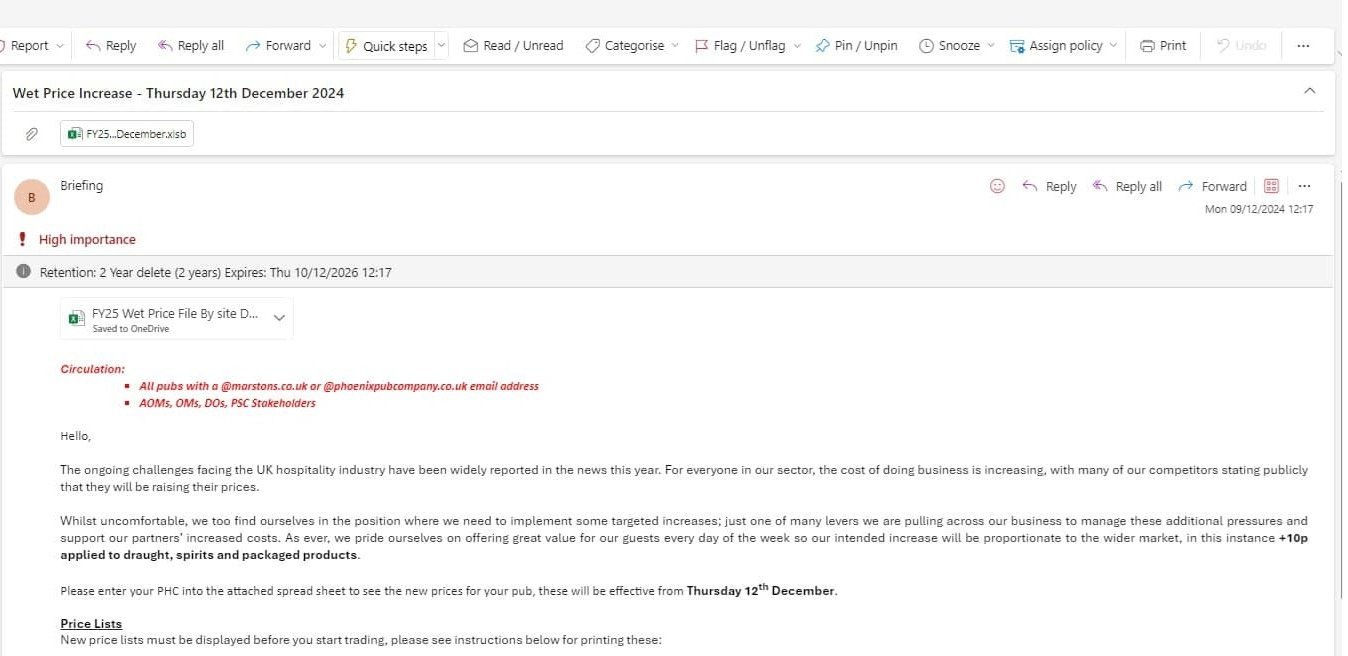
The pub (I won’t name them here) were not impressed. Apparently they have not been reaping the rewards in the same way as the Marston’s shareholders. The post that accompanied the email read:
Now my posts are normal just light hearted and jokes. Not this one!!!!
We received an email this morning informing us of yet another price increase of 10P across the board on all alcoholic drinks.
Now this is out 9th price rise in 2 years and I want everyone to know that me and [staff member’s name redacted] do not have anything to do with pricing and we think it is ridiculous just like you do. We don’t support it and we don’t agree with it at all!
It is discusting the price of beer these days and it is totally understandable how people will react.
All we ask is that you do not take out your frustrations on Me, [name redacted] or any of the team here as we have had nothing to do with it and don’t condone it we didn’t know it was coming and it is unfair for us to take the brunt of everyone else’s anger and frustrations like we have with previous price rises.
Are Marston’s being forced by the market to increase costs “proportionate to the wider market” that their licencees do not agree with because of the “ongoing challenges facing the UK hospitality industry”? Even though they were reporting “strong financial results” to the press on the same day that they were telling publicans to up their prices? I don’t know the answers to these questions. You are most welcome to nip to Blackpool, buy a few more postcards and furnish me with some answers. I don’t have any. It just all sounds a bit strange.
Anyway, there are my early evening musings laid out. Bit of a brain dump really. Corrections on points of fact are welcome and the insight of more expert minds than mine is also positively encouraged in the comments below.



The closure of Banks’s, and associated loss of brands, stems from San Miguel moving their contract from Carlsberg to ABI. The volume is probably more than is made at Banks’s or Marston’s and it leaves CMBC with a lot of overcapacity . So, shift the bigger brands at Banks’s to Marston’s or Northampton, ditch some of the smaller brands and close the brewery.